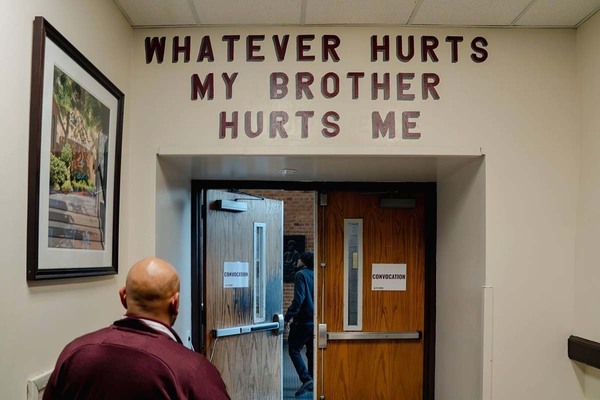
Several times a year, scores of pilgrims from points distant make their way to one of the most remarkable Benedictine abbeys in North America. Unlike monastic communities that are perched atop majestic mountains or nestled within secluded groves, this singular abbey sits stoically, even stubbornly, where it has for more than 150 years — in the grubby concrete heart of the old and mostly unloved city of Newark, New Jersey.
The pilgrims — teachers, principals and other education professionals — come to witness the exceptional, 53-year experiment that the monks of Newark Abbey run here. These dedicated men have taken a traditional Catholic college prep that once helped untold numbers of families enter the middle class and totally transformed it, turning it into an unequaled model of urban education, a prep school attended mostly by Black and Latino youths — many from disadvantaged or dysfunctional families — that against all odds routinely graduates nearly 100 percent of its senior class, sends almost every alumnus on to college, and prepares them for life in ways no other school does.
What these curious visitors encounter is a prep school without pomp, pretense or patrician admissions. Entering from bustling city streets, they find students who other schools might barely tolerate leading daily assemblies, and doing it so effectively that it takes them no more than a raised hand to silence bleachers filled with roughly 800 city kids. They see how lockers are routinely left unlocked, students go all day without cell phones and classes are held 11 months of the year with few days off. They learn how the school treats the depression, anxiety and anger these city-toughened kids harbor, while expecting them to excel academically and adhere to high standards of honesty, empathy and compassion. They are astonished to discover that these teens routinely meet extreme physical challenges: enduring a rugged, week-long freshman bootcamp, surviving a blistering 55-mile hike on the Appalachian Trail, and going through mock-disaster response training so demanding that it makes some parents squeamish — all of it meant to build character and foster teamwork. And depending on when they arrive, the visitors may even find students working as the school’s janitors, sweeping floors, shoveling snow and clearing cafeteria tables to help pay their tuition.
The curious educators all have the same question, and it’s not how the monks teach algebra, or which foreign-language program they use. What they want to know is how St. Benedict’s Preparatory School gets urban adolescents — a demographic generally considered among the most difficult to reach — to buy into a rigorous program of study, self-sacrifice and open-ended commitment to each other. And once they hear about the monks’ own stubborn commitment to this place, these kids and this city, they desperately want to know how they manage it in an era when truth is questioned, faith is challenged and empathy seems outpaced by envy, jealousy and suspicion.
The person they ask is Glenn Cassidy ’94. The man known to everyone as Cass clearly revels in busting educational myths, arguing in a calm, confident voice that most educators are going about it all wrong. No matter what academic programs or innovative trends are deployed in classrooms, he insists, urban education is undercut unless the students’ basic emotional and psychological needs are addressed. In short, it’s no use trying to reach the minds of these students unless you first attend to their hearts.
Originally published by Notre Dame Magazine at magazine.nd.edu in its Winter 2025-26 issue.