Angela Olvera recently graduated in May 2026 as a Political Science major, Latino Studies supplemental major, Latino Studies Scholar Program alumna, and former Institute for Latino Studies research assistant whose work spans Supreme Court scholarship, state-level policy advocacy, and national public service. After internships at the White House, the Council on Foreign Relations, and the U.S. House of Representatives, she will attend Columbia University Law School.

Angela Olvera’s senior thesis title reads like a table of contents, and that is part of the point. “The Politics of Precedent from 1953 to 2026: Stare Decisis, Political Ideology, and the Supreme Court’s Tumultuous Policymaking Role,” is a 70-page project built to answer a practical question: how has the Supreme Court’s reasoning changed across eras, and how do those changes show up in the language of modern decisions. Rather than treating precedent as a fixed rule, Angela set out to create “traceable evidence” that the Roberts Court often reaches new outcomes by emphasizing different parts of prior rulings, what she describes as working through “incomplete precedent,” instead of overtly overturning case law. She tested that idea on cases with immediate public impact, including affirmative action and other recent rulings, keeping the research grounded in the Court’s current policymaking role.
That blend of rigor and relevance runs through the rest of her Notre Dame record. As a co-lead for the Indiana Driving Record Card Project with the Notre Dame Student Policy Network, Angela worked with Indiana legislators and community advocates to support driving privilege cards for undocumented Indiana residents. Her interview notes point to something she took seriously throughout the project: policy lands differently when it is rooted in a local community, not just in a distant building. She and her team partnered with a Latino parish community as a home base for the work, which made the stakes tangible and strengthened the team’s long-term commitment.
Within the Institute for Latino Studies, Angela has held roles that sit at the center of ILS’s mission: supporting scholarship, building community, and helping students translate opportunity into action. She describes ILS as the rare academic space where Latino identity and Latino futures are not treated as a “subsection” of something else, but as the core focus. That framing matters in her work because it matches how she approaches law and policy: not as abstract systems, but as structures that shape people’s daily lives, especially for Latino communities whose rights and protections are often contested in real time.
Angela’s internships reflect the same seriousness and range. She interned in the Biden-Harris White House in the Office of the Vice President, Public Engagement and Intergovernmental Affairs, where she describes being trusted with meaningful responsibilities early, from coordinating high-visibility events to drafting and helping send a weekly newsletter that reached hundreds of thousands of subscribers. She also supported background and security-related processes for events, which gave her a direct view into how public engagement work is planned and executed at the highest level. The following summer, Angela worked on the New York programming team at the Council on Foreign Relations, a research-heavy role where her final deliverable was a database of experts on Middle East foreign policy, built to be usable by teams planning future programming and discussions.
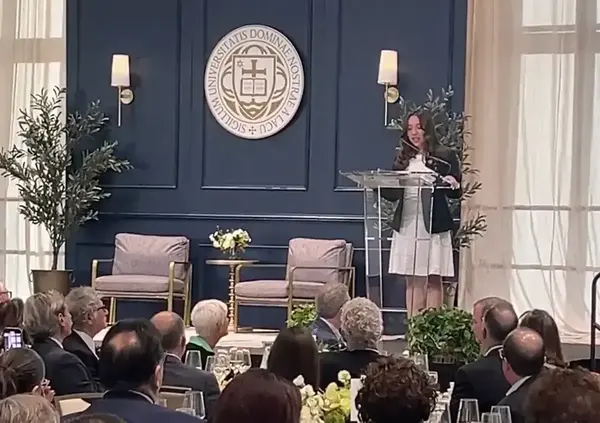
Earlier experiences show the consistency of her direction. Through Notre Dame’s Washington Program, she interned with Congressman Joaquin Castro’s office. Through the Cross Cultural Leadership Program, she worked at the National Immigrant Justice Center on the Children’s Protection Project, an experience she directly connects to ILS support and sponsorship through an ILS board member. During her senior year, she also interned with Notre Dame Law School’s Exoneration Justice Clinic, an opportunity she traces to relationship-building through the ILS 25th anniversary panel, which her parents were able to attend.
Angela is equally direct about how she grew into these opportunities. She says she became comfortable with rejection, and that change made her more willing to apply broadly, take risks, and treat the process as part of building a career rather than a verdict on her ability. She also credits mentorship that was both practical and consistent, especially Dr. Luis Fraga, who supported her as a professor, thesis advisor, and trusted voice in major decisions.
He says, “It has been a true pleasure to be a part of Angela's leadership journey. Students like her are precisely the reason why Our Lady's University needs the Latino Studies Scholars Program, and our scholars in turn benefit so much from simultaneously developing their career, Catholic identity, and courage to be a force for good in their communities. It was a pleasure to work with her on her honors thesis in Political Science, “Stare Decis and the Robert’s Court.”

Next fall, Angela will enter Columbia Law School as a J.D. student after accepting a scholarship contingent on accepting a one-year deferral. Along the way, she has earned recognition that reflects both academic excellence and public-service commitment, including Obama-Chesky Voyager, LSAC Plus Scholar, and Hesburgh Democracy Fellow, as well as multiple Dean’s List semesters, Notre Dame Scholar recognition, and the Latino Studies Scholars Program distinction. Her work points to a clear professional throughline: building legal and policy expertise that keeps pace with a changing country, and insisting that Latino communities are not an afterthought in those conversations.
When Angela talks about what she will miss most about Notre Dame, she keeps it simple: the concentration of people who shaped her here, friends, classmates, professors, and mentors, all within reach. And on a campus that can move fast, her favorite place reflects how she works: the booths in LaFortune, where plans get made and work gets done.
The Institute for Latino Studies is proud to celebrate Angela’s accomplishments and looks forward to all that she will achieve in the future.
Originally published by at latinostudies.nd.edu on June 10, 2026.