
As the U.S. reckons with a national political culture defined by deep division, the Keough School of Global Affairs convened nearly 30 Notre Dame students last week for thoughtful, structured conversations focused on politics. Moderated by members of BridgeND, the lunchtime discussions brought together student leaders from across the political spectrum — College Democrats and College Republicans, Democracy Fellows, Tocqueville Fellows, global affairs majors and students in the Master of Global Affairs program — to exchange views on pressing political challenges shaping the United States and other countries.
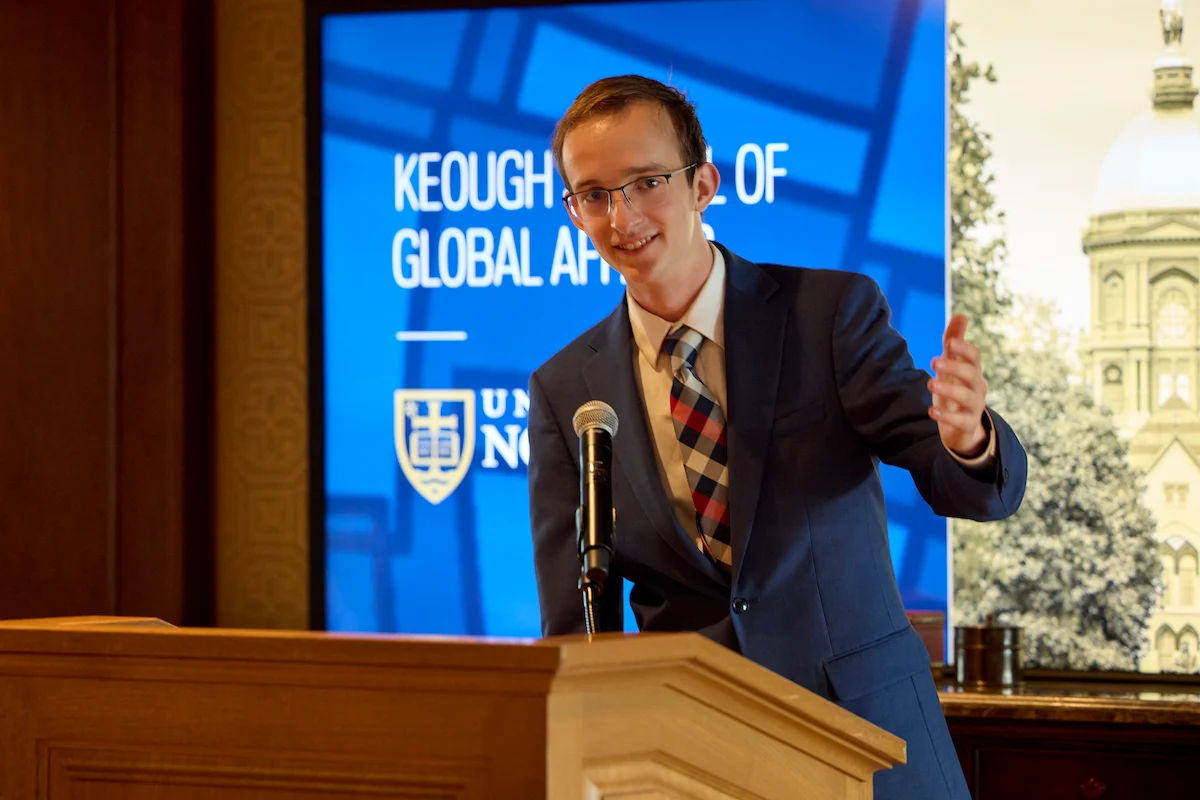
Keough School Dean Mary Gallagher opened the event by welcoming students and highlighting the importance of civil engagement. Assistant Dean for Academic Affairs Dory Mitros Durham praised the participants, who were nominated by their respective programs, for their willingness to confront difficult topics through respectful discussion.
“You are here because you have already demonstrated commitment to thoughtful dialogue and political engagement,” Durham said. “We wanted to create a space where students could engage each other not as partisans, but as citizens — people who care deeply about the future of our democracy. My hope is that you all leave today with renewed conviction that disagreement can be productive when it’s grounded in respect.”
At each table, moderators from BridgeND, Notre Dame’s bipartisan political discussion group, guided conversations on topics ranging from the ongoing U.S. government shutdown to immigration policy to recent election results in New Jersey, Virginia and New York City.
Ryan Lally, a Tocqueville Fellow majoring in classics and Spanish with a minor in theology, observed that for many students, the government shutdown seemed distant from everyday campus life.
“Most Notre Dame students are sheltered from the effects of the government shutdown,” Lally said, noting that for many, the impacts feel abstract.
Global affairs major Max Kitchell agreed, pointing out that the only direct effects he’d heard about were among ROTC students, who had encountered difficulties registering for classes or accessing transcripts during the shutdown.
Christina Ayón, a junior studying global affairs and peace studies with a minor in Latino studies, expressed concern that the preservation of air travel was viewed by many Americans as the most pressing reason to end the shutdown. She steered the conversation towards the human toll behind the current political stalemates.
“If either side concedes, it’s seen as a political loss,” Ayón said. “It’s sad we’re talking about planes instead of people — who are the American people worthy enough to end the shutdown for? What about those who have no food or aren’t getting paid?”
Students also engaged in spirited discussion on the morality and legality of immigration enforcement. Alexandra Funk, political director of the College Democrats and a political science and history major, voiced concern about the erosion of constitutional norms.
“ICE is ignoring constitutional principles,” Funk said. “No matter your political stance, that’s important. The U.S. Constitution is being completely ignored, and it sets a dangerous precedent.”

Mustafa Hess, a global affairs major with minors in French and peace studies, referenced the ICE raids in nearby Chicago and lamented that more people were not protesting the government agency’s actions.
“Here we are, two hours away and not doing anything about it,” Hess said.
Ignacio Guarachi, a master of global affairs student from Ecuador, shared his experiences discussing immigration during informal conversations with Americans.
“You have no idea how many people said to me, ‘You changed my mind,’” Guarachi said. “Political discourse has become so radicalized. Most people don’t get the chance to interact with someone from Ecuador — ever. When you talk to someone one-on-one, you see them as a human being.”
For Guarachi, meaningful change begins with conversation.
“People should make up their own minds based on personal interactions, not just what they see in the media,” he said.
As the event concluded, students lingered in conversation — a small sign, perhaps, of dialogue’s enduring power even in polarized times, and a signal that meaningful change often begins outside Washington, around the table.
“When students engage each other across political divides with curiosity and respect, they show what’s possible for our country,” Durham said. “Productive dialogue like this isn’t just about understanding one another — it’s about finding the common ground we need to move forward in a productive and fruitful way that benefits us all.”

Originally published by at keough.nd.edu on November 14, 2025.