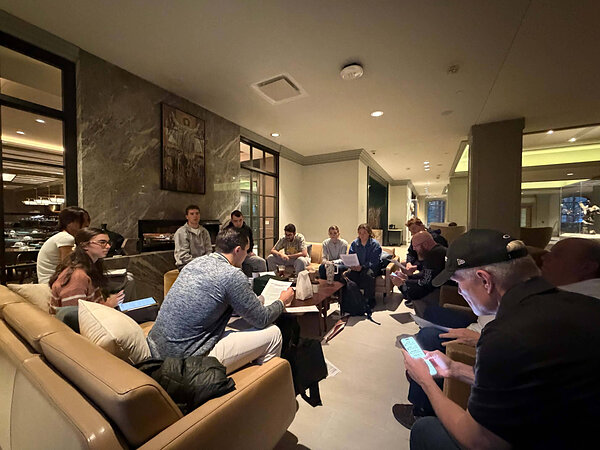
Transitioning from military service to a college campus is rarely a straightforward march. For many veterans, the sudden shift from the absolute clarity of military life to the fluid rhythms of civilian academia brings a distinct sense of whiplash. The uniform is packed away, hard-earned ranks are voluntarily laid down, and a profound, built-in sense of communal life vanishes overnight.
Recognizing a deep need to support the spiritual and interior lives of these service members, the Office of Military & Veterans Affairs (OMVA) launched a groundbreaking new initiative this spring: Centurion Circle.
Meeting every Wednesday morning, the military-connected community Bible study provides a dedicated space for student veterans, active-duty service members, faculty, and staff to gather for fellowship and rigorous spiritual reflection. Co-led by Military & Veterans Affairs Assistant Director Michael Labbe alongside NDISC student and U.S. Army War College Fellow Chaplain (COL) Emmit Furner, the program approaches ancient scripture not through abstract theology, but through a raw, tactical lens built specifically for those who have worn the uniform.
A Legacy of Trust and Authority
The initiative takes its name from one of the most compelling figures in the Gospels: the Roman Centurion. A battle-tested military commander responsible for a hundred soldiers, the Centurion approached Jesus with a profound understanding of authority, discipline, and duty. Yet, it was his radical humility and absolute trust that struck such a chord that Jesus turned to the crowd and declared He had found no greater faith in all of Israel.
Centurion Circle challenges Notre Dame's military-connected scholars to embody that same blend of leadership and humility under the Dome. Rather than passive reading, the group treats each session like an After-Action Review (AAR)—dissecting scripture to confront the complex, often isolating realities of transitioning back to civilian life.
From Desert Grumbling to the "Locked Room"
The curriculum explicitly tackles the psychological, logistical, and spiritual terrain of life after service, beginning with the long trek through the desert. Looking at Israel’s wanderings in Exodus, the cohort wrestled with the "Egypt trap"—the temptation to romanticize the past and look back at the military with rose-colored glasses when civilian supply lines, finances, and academic schedules feel unstable. The sessions challenged veterans to move past temporary fixes and "temporary wells" to find a sustainable identity that doesn't rely on old survival tactics.
This theme carried directly into the deep fog of the transition itself. In the curriculum unit "Reconsolidating After the Storm," the cohort analyzed the text of John 20, where the disciples find themselves hiding behind locked doors out of fear and confusion following the execution of their leader. For many veterans, the early stages of navigating a massive university can feel exactly like that "locked room"—a defensive posture where the outside world feels foreign, and individuals find themselves metaphorically pulling security on their own lives.
Through the lens of the Gospel, the group discussed how Christ didn't reprimand the disciples for hiding; instead, He stood in their midst, offered peace, and handed them a new mission. The session challenged participants to find a similar, renewed sense of purpose within their current academic chapters to draw them out of isolation, even when operating in the deep "fog of war" of a new civilian environment.
The Credentials of the Scars and the Lazarus Stone
The study also dives headfirst into the heavy concepts of vulnerability, grief, and identity. In a poignant discussion on the skepticism of Saint Thomas, the group reframed the hidden wounds carried by service members. Rather than treating physical, mental, or moral scars as liabilities to be masked by a professional front, the curriculum highlights how Christ used His wounds as His primary credentials to prove who He was.
This was paired with an intense look at the raising of Lazarus, where the cohort discussed the unique patience required when "spiritual air support" or civilian breakthroughs feel painfully delayed. The group reflected on the profound vulnerability of the weeping Commander, noting that Jesus models a healthy space to grieve the structures and communities left behind. Furthermore, the text reminded veterans that Christ demands the community do the heavy lifting of rolling away the "stones" that keep them entombed. For the veterans in attendance, it served as a powerful reminder that their shared struggles, survival, and the process of being "untied" from past baggage are precisely what make them recognizable, trustworthy leaders to their peers.
Stripping the Rank to Lead from the Bottom
Another cornerstone session, "The Parade, the Rank, and the Sleeping Guard," confronted the intense whiplash veterans experience between public adoration—the reflexive "thank you for your service" heard on Palm Sunday—and the stark, personal isolation that often follows by Friday.
Using the framework of the Passion and Christ’s voluntary decision to "empty himself" of the ultimate rank to assume the role of a servant, Centurion Circle addresses the ego hit that many older, non-traditional students face. Stepping onto a campus like Notre Dame often means leaving behind hard-earned titles, authority, and tactical responsibility to become "just another student" or a new hire at an entry-level job.
The curriculum reframes this transition not as a loss of power, but as an opportunity to exercise true leadership. It addresses the disappointment felt when civilian support systems or institutions occasionally "fall asleep on watch," reminding veterans that real authority does not require a collar device or a shoulder patch. Instead, it requires a willingness to maintain operational bearing under fire, serving and strengthening the unit from the bottom up.
Building Communal Life 2.0
Ultimately, Centurion Circle is doing more than analyzing text; it is actively rebuilding the intense, built-in "unit cohesion" that service members lose when they leave active duty. By gathering weekly to break bread, share burdens, and process the refining fire of academic rigor, the cohort is forging an elite spiritual unit right here on campus.
Centurion Circle has quickly solidified its place as a vital anchor for Notre Dame's military-connected family—proving week after week that our scars are not flaws to be hidden, but the very credentials that empower us to lead with sincerity of heart and a clear mission under the Dome.
Originally published by at omva.nd.edu on September 03, 2026.