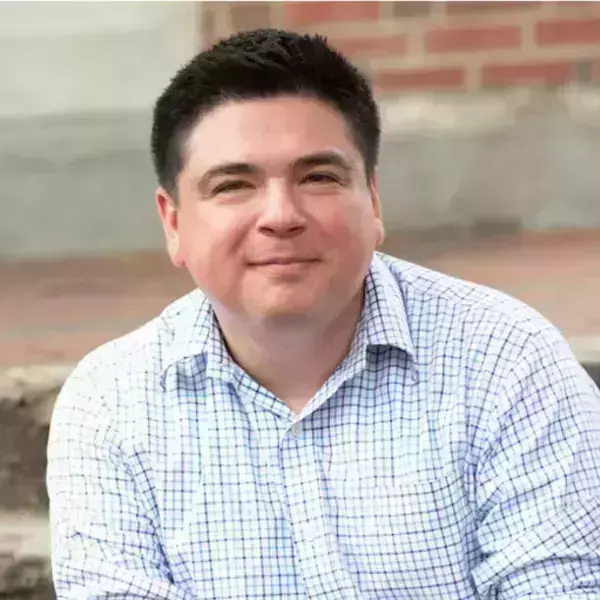
A bridge is more than a sidewalk or a pathway. A bridge is strong enough to support the weight of a person, or of millions of people. Whether it be a small footbridge over a creek, or the Golden Gate bridge, the purpose is the same: to support people in their journey from one side to another. At Notre Dame, there are many bridges, though more metaphorical. Bridges within the school, and bridges that bring people from where they’re at into the university. For Professor Oscar Gonzales, bridges serve as the foundation of his education and his work.
Oscar first stepped onto the campus of Our Lady’s university back in 2008 when he was just a high school student from Texas experiencing a South Bend winter for the first time. Originally from Monterey, Mexico, Gonzales’s father moved the family to Los Fresnos, Texas during his early teen years. All through high school, Oscar joined and continuously moved up the ranks of the junior ROTC. Because of this, he originally thought he might join the Navy after graduation. However, due to his discipline skills from ROTC that transferred to academics, Oscar graduated as valedictorian and was encouraged by those around him to get out of the valley and explore college opportunities that would make the most of his skills. During a meeting with his high school counselor, a different counselor walking by offhandedly recommended that he look into Notre Dame. Oscar ended up applying to several schools across Texas and across the country, with Notre Dame being one of those.
Unexpectedly for Oscar, he not only received admission to the university, but he was also offered a full-ride scholarship. This was the first bridge Oscar crossed in his journey to Notre Dame. With a full-ride being hard to turn down, Oscar accepted his offer and was set to join the Notre Dame class of 2012. Oscar was also accepted into the Balfour-Hesburgh scholars program, which brought him to campus for a few weeks in the summer before his fall semester. This program was one of many offers that Oscar received. Another one was the offer to apply to the Building Bridges program. After receiving the letter informing him about it, Oscar realized that Building Bridges was a way to combat some of his fears about being away from home because it had the aspect of having a faculty mentor to talk to. He was accepted to the program and was matched up with former chemistry professor, Ken Anderson. Upon entering college, Oscar was set on majoring in chemistry. However, as the semester progressed, he was struggling more and more in the general chemistry classes. He soon realized that chemistry was not the path destined for him.

Oscar credits Professor Anderson with being a main reason why he was able to eventually switch majors over to psychology. Having a mentor easily accessible off the bat of freshman year was a way for Oscar to talk openly and honestly about the struggles he was going through. Having a support system is what Building Bridges is all about. Without support, the bridge would crumble, and Oscar might have been stuck in a major that didn’t suit him. Switching to psychology proved endlessly rewarding as it became Oscar’s passion and he continued to study it all the way through his PhD studies and beyond into professional research and teaching.
After graduating from Notre Dame, Oscar took a one year research position at a psychology lab because his statistics classes piqued his interest in quantitative psychology. After the year working in the lab, Oscar continued his education at Arizona State University, getting his PhD in quantitative psychology. After working for seven years at the University of North Carolina, Oscar–now known more as Professor Gonzales–felt the call to return to the place that gave him his start. He was offered tenure at Notre Dame, and like the first time around, it was very difficult to say no. Since being back, Professor Gonzales has had the opportunity to relive the memories of his college days, and can be more involved with students, teaching classes about machine learning, as well as other undergraduate psychology courses. Oscar followed the bridge back home.
What’s remarkable about Oscar’s return to the University of Notre Dame is that he is the first graduate of the Building Bridges program to return as a faculty member to the university. Oscar says that Notre Dame has supported him a lot throughout his whole career, especially due to their help with financial aid and with the many faculty members that guided him to his passion and work. But not only does Professor Gonzales instruct the next generation of psychologists, he also partakes in his own research.
With a particular interest in quantitative psychology, Professor Gonzales knows what he is fighting for: doing science right. His studies include figuring out ways to analyze data fairly and treating protected populations equitably. When it comes to data in psychology, the statistics are real people and their lives, and thus should be treated as more than just numbers. Professor Gonzales and the quantitative psychology program of a uniquely large eight researchers are devoted to using machine learning to analyze intervention data, following the philosophy of approaching science skeptically. Data from human beings is in Oscar’s own words, “crappy,” so it’s up to researchers like him and his team to accurately make claims, and not to generalize entire populations. Doing science right means broadening the base with statistically significant and accurate data. In other words, Professor Gonzales’s work is crossing a bridge in itself–it supports the needs of many, it’s strong and is built on solid foundations, and it brings people from the unknown over to accurate psychological care.
Oscar Gonzales attributes much of his success to Notre Dame’s help–“Helping me out since 2007!”–but he stands as a shining example of what Notre Dame really is. The bridges Oscar crossed to get to the university were just the starting point for all the bridges he crossed and the ones he continues to build. Through Oscar’s education and work, he has bridged the gaps between Monterey, Los Fresnos, and South Bend; between a struggling first-year student and his faculty mentor; between undergraduate studies and post-graduate education; between research and teaching; then finally crossing the bridge back home where he can continue to bridge students with real-world research, and bridge research with real-world change. Professor Gonzales–backed by the strength of the bridges he’s built–is a force for good in the Notre Dame community.
Originally published by at msps.nd.edu on January 18, 2026.