
The Catholic Church is the most global, multicultural, and multilingual organization in the world, and its growth over the past half-century in Africa has been particularly dynamic. Home to more than 265 million Catholics, Africa’s totals will soon surpass those of Europe. As the Church’s presence in the Global South continues to grow, what do we owe to our neighbors around the world?

For the final event of the 2024-25 Notre Dame Forum, focused on the theme, “What do we owe each other?”, the Institute for Ethics and the Common Good brought together thirteen Notre Dame faculty and administrators from various disciplines and perspectives to engage with this question through the fifth annual Zahm Retreat. Retreat participants traveled to Nairobi, Kenya, to explore the Catholic social tradition from a global perspective, focusing on the Church in eastern Africa and in particular on ministries of the Congregation of Holy Cross, Notre Dame’s founding order.
Named after Rev. John A. Zahm, C.S.C. (1851-1921), an influential faculty member and administrator who bolstered Notre Dame’s research reputation and worked to bridge the divide between the sciences and religion, the Zahm Retreat brings together faculty and administrators from various disciplines and perspectives to engage with a current, ethically complex issue facing higher education through the lens of the University’s Catholic mission.
“The Congregation of Holy Cross and the University of Notre Dame have a deep connection with Kenya,” says Meghan Sullivan, Wilsey Family College Professor of Philosophy and director of the Institute for Ethics and the Common Good and the Notre Dame Ethics Initiative. “It was a transformative opportunity for our faculty and staff to spend time in relationship with Catholic leaders and educators in Nairobi. It deepened our understanding of Notre Dame’s Catholic mission and inspired us to think in new ways about how to strengthen Notre Dame’s connections with the region. And in taking a great journey like this with colleagues, we were able to grow our own relationships and our shared commitment to advancing Notre Dame.”
While in Kenya, Zahm participants stayed in Roussel House, a ministry of the Society of Apostolic Life, or Donum Dei Sisters, located in the Karen neighborhood of Nairobi. This location gave the Zahm team the opportunity to interact with African bishops, leaders in Catholic higher education, and leaders of nonprofits who were also staying at Roussel House, creating rich, invigorating dialogue about the role of the global Church and the election of Pope Leo XIV. The Sisters also operate St. Therese Technical & Vocational College, which provides apprenticeships and technical educational programs for young people.
As they spent time with these students, Zahm participants gained a sense of the deep importance of hospitality and community in Kenyan culture, which extends far beyond the circle of immediate family.
"Hearing these students talk about the ways they hoped to use their education to improve the lives of others in their communities was really humbling,” says China Scherz, professor of global affairs in Notre Dame’s Keough School. “In thinking about the question, "What do we owe one another?", we clearly have a lot to learn from them. If we, as an institution and as individuals, can learn to see ourselves as part of these communities and model our actions on theirs, we could go a long way toward finding better ways to respond to this crucial question with a real sense of solidarity."

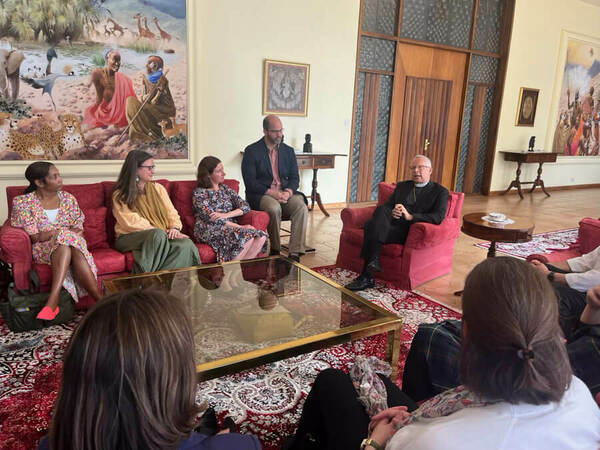
The Zahm team met with Archbishop Hubertus Matheus Maria van Megen, Apostolic Nuncio of Kenya, at his residence. From him, they learned about the role of the Catholic Church in Kenya and the complex relationship between Church and state.
Powerful moments for the group included visiting several ministries of the Congregation of Holy Cross that are active in Nairobi. On Sunday, they prayed at Holy Cross parish in Dandora, a large, low-income area of the city where the Congregation established a parish in the late 1970s, taking part in a vibrant liturgy. They also visited the parish’s Saint James Primary School and Brother Andre Hospital, a highly regarded provider of affordable medical services, including maternity care, to residents of Dandora and throughout Nairobi. The Zahm participants spent an evening at McCauley Formation House, where they had Mass and dinner with the dozens of Holy Cross seminarians and brothers in formation for the Congregation in Nairobi.
“Holy Cross parish in Dandora is a vibrant faith community and a beacon of hope, providing faith formation, education, and healthcare to thousands each week,” says Rev. Paul Kollman, C.S.C., one of the participants in the retreat. “Shaped for many decades by dynamic small Christian communities, the parish represents the fruit of decades of Holy Cross leadership in Nairobi.”

Other service providers that the Zahm participants were able to visit included the Nyumbani Children’s House, a ministry that cares for some 100 HIV-positive orphans and abandoned children, and Jesuit Refugee Services, whose regional office for eastern Africa is in Nairobi. The group also met with representatives of Kenyan-based institutions of higher education, including Hekima University—where University President Rev. Robert Dowd, C.S.C., and Fr. Kollman both studied as seminarians—and the Catholic University of Eastern Africa.
Throughout the Zahm retreat, scheduled group reflection and discussions helped participants process opportunities and complexities inherent in what it means to be a global Catholic research university, leaning into questions related to global interdependence, accompaniment, and prioritizing local voices in decision making. Ultimately, participants came away with a deeper understanding and appreciation for what it means to be in solidarity with a global community.
“Our group saw many wonderful examples of people using their particular gifts to meet the needs of others,” says Kasey Buckles, professor of economics. “It has inspired me to look for ways to do that in my own life, and to encourage Notre Dame to do that as an institution. We can't do everything, but we are called to find those opportunities to serve the common good by doing what we do best.”

Throughout the Zahm Retreat, participants received expert support from Jackie Oluoch-Aridi, director of ND Nairobi, and her team, making it possible for the participants to experience Kenya as fully as possible.
Topics addressed at past Zahm Retreats have included the use of generative AI in higher education; the role of universities in finding solutions to the climate crisis; the law, migration, and criminal justice reform; and Notre Dame’s work to create an inclusive University community.
____________
The Institute for Ethics and the Common Good is at the heart of the Ethics Initiative, a University-wide effort to establish Notre Dame as a premier global destination for the study of ethics. Under the leadership of Meghan Sullivan, Ethics Initiative director and Wilsey Family College Professor of Philosophy, the institute focuses on cross-disciplinary ethics research, undergraduate course development, the moral formation of its students and faculty, and engaging the public in meaningful dialogue around ethical issues.
Originally published by at ethics.nd.edu on May 27, 2025.