Unifying. Energizing. Thoughtful. Compelling. Inspiring.
Attendees used these words and others like them to describe the 2025 Notre Dame Inclusive Teaching Academy (NDITA), which took place the first week of June at the Palmer House Hotel in Chicago.
Hosted by Notre Dame Learning’s Kaneb Center for Teaching Excellence, NDITA features invited keynotes, sessions led by members of the Kaneb Center team, and structured work time for participants to take what they’re learning and apply it to their own course planning. The theme for the 2025 academy was “(Re)Designing for Inclusion, Equity, and Justice: Making Learning More Accessible.”
“This was our fourth NDITA,” said Horane Diatta-Holgate, program director of inclusive pedagogy at the Kaneb Center, who organized the three-and-a-half day event with Nara Schmitt, the Kaneb Center’s office coordinator. “We continue to be guided by the idea that the academy should be a place where faculty have the opportunity to reflect and connect in a small-group setting with like-minded colleagues to discuss and explore high-impact, concrete teaching practices and strategies to promote the success of all students, in the classroom and beyond.”
The academy targets a roughly 50-50 split between faculty from Notre Dame and elsewhere and covers the cost of registration, lodging, and breakfast and lunch for all of them. This year’s cohort of 26 participants represented 12 colleges and universities.
Mays Imad, an associate professor of biology at Connecticut College, gave the week’s first interactive keynote on “Cultivating Learning Sanctuaries: Theory and Practice.” Her approach to teaching and learning is grounded in how the human nervous system perceives and interacts with the world, and she encouraged attendees to view their courses as places of refuge that will inspire students to “bounce forward” from challenges.
She believes such learning sanctuaries allow both instructors and students to temporarily step away from the demands and distractions of daily life to find themselves in the learning process, fostering collaboration and enabling all to do their best work.
“What I hope for my colleagues at NDITA to walk away with from my session is that we all have the ability to co-create welcoming, equitable, and empowering spaces for deep learning that nurtures healing, wisdom, well-being, and resilience,” Imad said.
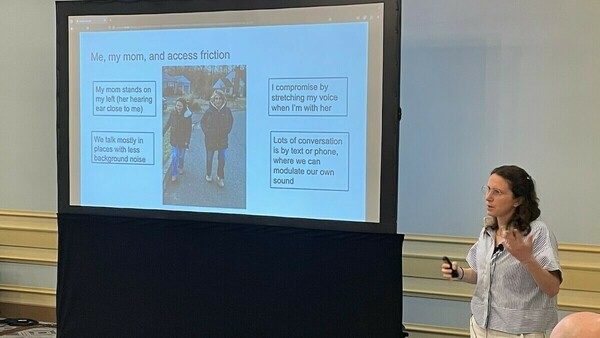
Sarah Silverman, an independent faculty developer and instructor of disability studies, delivered the academy’s second keynote. In a talk titled “Access Friction: What Can We Learn From Situations in Which Access Needs Differ and Conflict?,” she led attendees through an exploration of potential unintended consequences of well-founded efforts to create more welcoming classrooms.
Among the examples Silverman pointed to was a study where a teaching practice that helped students with dyslexia actually had adverse effects on other students’ learning. Noting the relative lack of attention that has historically been paid to neurodivergent conditions like dyslexia in the inclusive teaching literature, she said access friction can in fact be a good thing because it means instructors are seeing and responding to multiple needs.
“Friction is not a crisis, but it does often involve compromise,” Silverman said, offering a framework for how instructors might navigate various barriers to student participation.
In addition to the two keynotes, Kaneb Center faculty members Kristi Rudenga, Alex Ambrose, Ashley Henry, Jim Lang, and Kathy Quardokus Fisher joined Diatta-Holgate in leading workshop-style sessions that covered topics ranging from setting goals for a course to crafting inclusive assessment plans.
Among these was “Redesigning Assessments for All: UDL, AI, and Academic Integrity,” where Ambrose, who directs Notre Dame Learning’s Lab for AI in Teaching and Learning (LAITL), and Lang asked attendees to share their opinions on appropriate and inappropriate uses of AI in their disciplines. Lang and Ambrose did the same—illustrating their own distinct perspectives on the subject—before turning to strategies instructors might employ to create assignments in the age of AI that are both inclusive and robust.
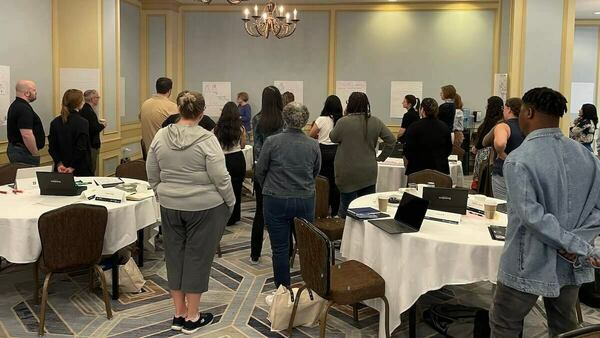
The academy’s final morning included a talk by 2024 NDITA participant Dana Lashley, an associate teaching professor in the Department of Chemistry & Biochemistry at Notre Dame, meant to help attendees envision applying what they learned throughout the week in their courses.
“Attending NDITA this week was an inspiring experience that deepened my commitment to designing an inclusive learning environment for everyone in my class,” said Ava Hedayatipour, an assistant professor of electrical engineering at California State University, Long Beach. “The highlight of my week was engaging with thoughtful colleagues in our fun small-group discussions and learning from powerful sessions on Universal Design for Learning and generative AI. NDITA has already begun to reshape how I envision my course planning and classroom culture moving forward.”
Helen Kilburn, an assistant rector at Notre Dame London, was struck in particular by the collegiality of the cohort and Imad’s and Silverman’s keynotes.
“I'm leaving it [NDITA] feeling very tired, but also very uplifted and feeling very proud to be at Notre Dame for the fact that they are putting this on, and putting it on for everyone,” she said, “seeing it as not just a Notre Dame endeavor, but a higher education one, too.”
About Notre Dame Learning
Notre Dame Learning houses the Kaneb Center for Teaching Excellence and the Office of Digital Learning, bringing together their teaching and learning expertise along with that of the OIT’s Teaching & Learning Technologies group to serve as the hub of learning excellence and innovation at Notre Dame. Working in collaboration with instructors, departments, and colleges, Notre Dame Learning aims to enable effective and engaging learning for all students through research-based strategies and effective use of technologies across all modalities.
Want Notre Dame Learning news delivered right to your inbox? Sign up for an email newsletter.
Originally published by at learning.nd.edu on June 13, 2025.